An Ottoman Jigsaw
4 January 2026
The biomorphic patterns of Ottoman ceramic tiles are beautiful. They arguably reached their apogee in the mid- to late-16th century, under the artistic impulse of exceptional directors of the Royal design workshop in Istanbul such as Şahkulu and Kara Mehmed Çelebi (also known as Kara Memi). The tiles were manufactured in Iznik using an underglaze painting technique, and commissioned and incorporated into Sinan's great mosques in Istanbul and other parts of the empire.
I highly recommend reading Walter B. Denny's Iznik - The Artistry of Ottoman Ceramics, the catalogue of Iznik Ceramics at the Benaki Museum, and İnci A. Birol's Motifler - Motifs in Turkish Decorative Arts, to learn more about those tiles. Less well-know, but also fascinating, are the so-called Damascus tiles, for which the eponymous book by Arthur Millner is informative and beautifully illustrated. The two types are largely contemporary but Damascus tiles can often be distinguished by their use of a more restricted colour palette which includes a chromium-based, apple green colour, while Iznik tiles feature copper-based turquoise and (in later years) emerald green.
Two of my favourite Iznik tiles are on display at the Art Institute of Chicago:
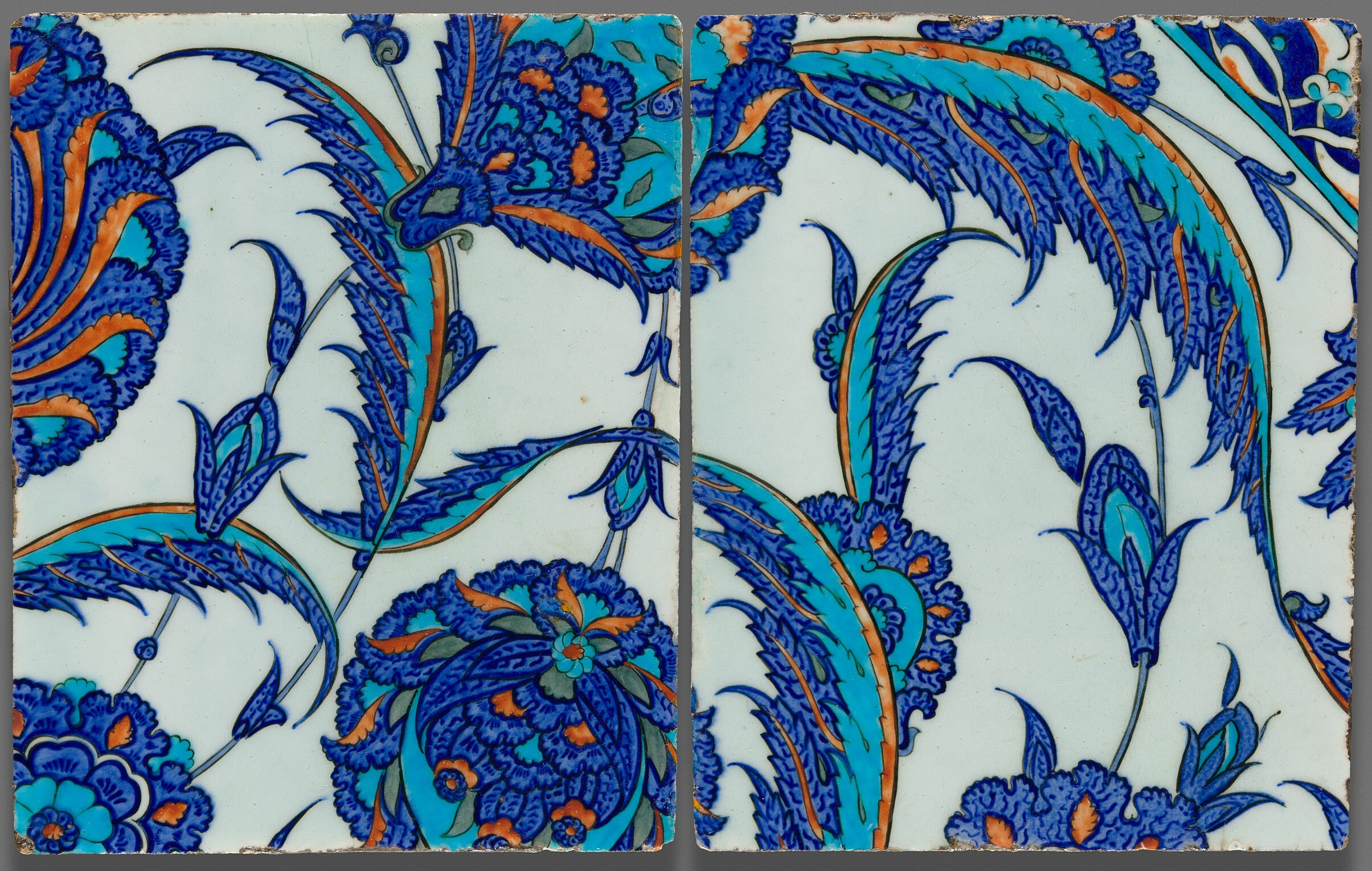
Iznik tiles (ca. 1560), Art Institute of Chicago. Source: https://www.artic.edu/artworks/72850/pair-of-tiles-with-floral-design. CC0 Public Domain license
They originate from the Mary Jane Gunsaulus Collection, fit together, and are obviously part of a larger pattern, but their provenance is not listed in the Institute's catalogue.
A bit of internet searching reveals that the mirror image of those tiles can be found in a medley panel in the Rüstem Pasha mosque in Istanbul (likely built between 1561 and 1563):
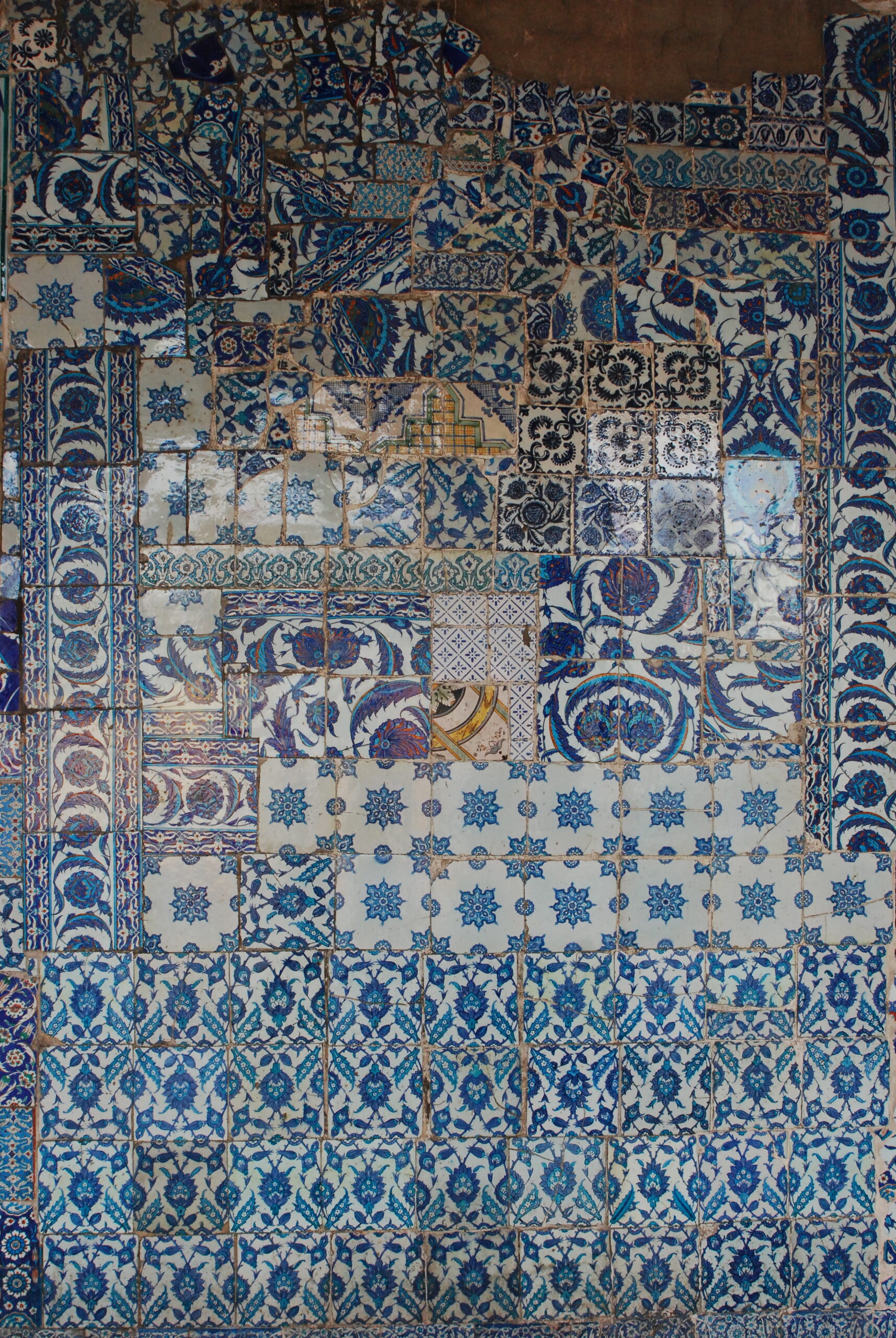
Medley wall panel of ceramic tiles, Rüstem Pasha Mosque, Istanbul. Photo: SebDech, source: https://www.flickr.com/photos/sebdech/21417660323/, CC BY-NC-ND 2.0 license.
This medley of disparate sets of ceramic tiles is described in Walter B Denny's 1977 dissertation on The Ceramics of the Mosque of Rustem Pasha and the Environment of change, which he has made freely available on his website. His analysis of the panel and of the specific subset of tiles we are interested in is on pages 74-78 (referring to figures 114 to 116 pages 348-349). Denny argues that the symmetry and shapes of those tiles suggest an original panel in the shape of an arch with spandrels. He also states that there is no strong stylistic evidence to suggest it came from a different building.
The flower at the bottom right of the leftmost tile is also almost identical to that illustrated in Figure 60 page 99 (and the cover) of Motifler, where it is labelled as coming from the Sokullu Mehmed Pasha mosque in Istanbul. I cannot show that illustration here for copyright reasons, but I believe it corresponds to the Wiki Commons image below, associated with the Wikipedia article on that mosque:
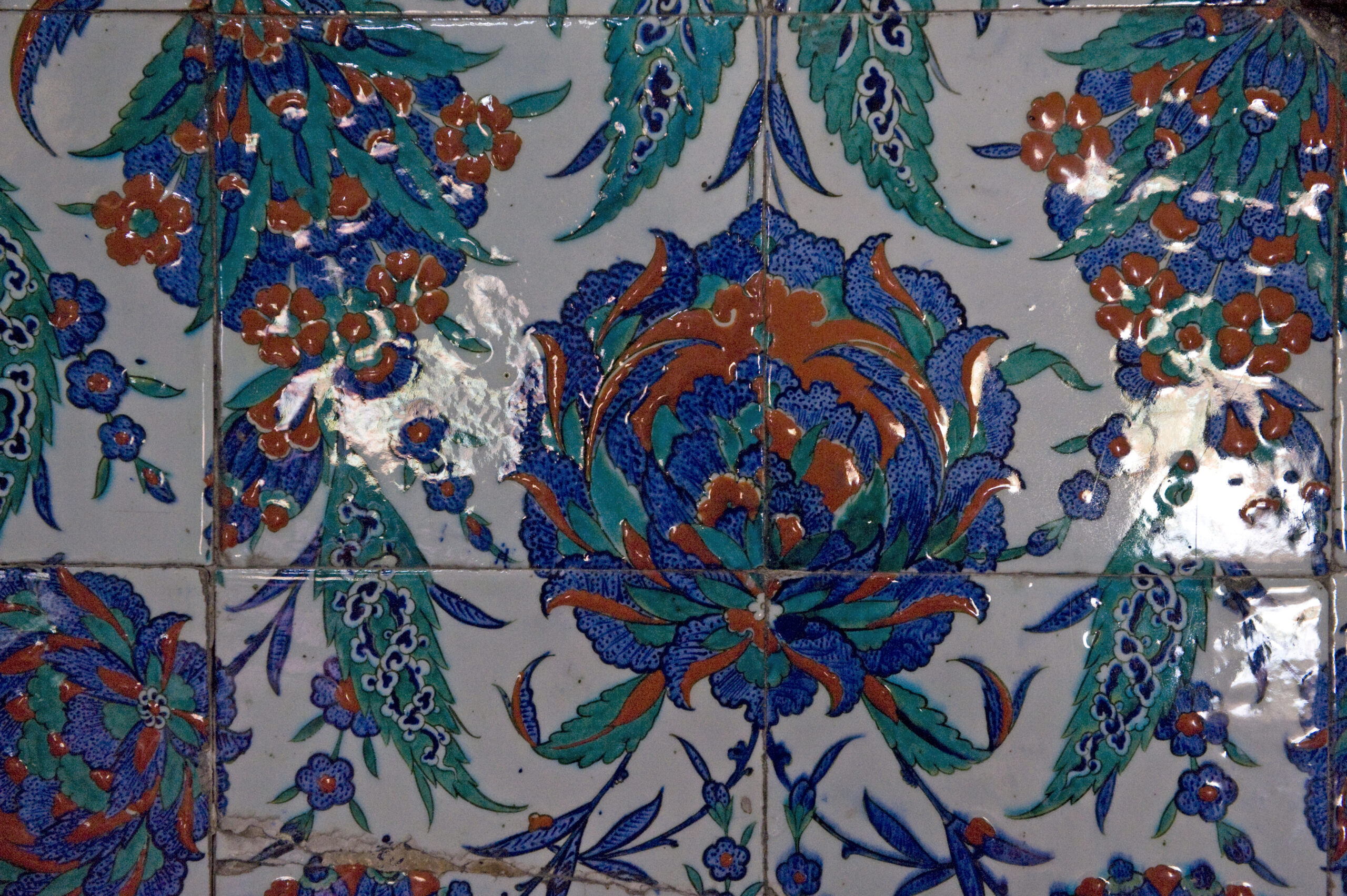
Iznik tiles, Sokullu Mehmet Pasha mosque, Istanbul. Photo: Dosseman (https://commons.wikimedia.org/wiki/User:Dosseman), source: https://upload.wikimedia.org/wikipedia/commons/8/82/Sokollu_Mehmet_Pasha_mosque_5702.jpg . CC BY-SA 4.0 license
Although the shape is near-identical, the colour palette is quite different. In particular, orange has been replaced by the newer bole red (from Armenian bole, a reddish clay containing iron oxide, applied as a slip under the glaze), whose earliest dated appearance is on a lamp from the Süleymaniye Mosque at the V&A Museum in London (c. 1557). The leaves also feature translucent emerald green, related to the earlier turquoise, and apparently introduced for the first time on the portico panels of Süleyman’s mausoleum in the funerary garden of the Süleymaniye complex, completed in 1567.
Going back to our panel in the Rüstem Pasha mosque, the jigsaw wasn't actually that complicated. Using Inskcape, it took a few hours of a rainy weekend in November to reconstruct the original lunette from the 50 or so pieces (either entire tiles or fragments) whose style indicate that they might belong together. Those pieces are shown bordered in red below:
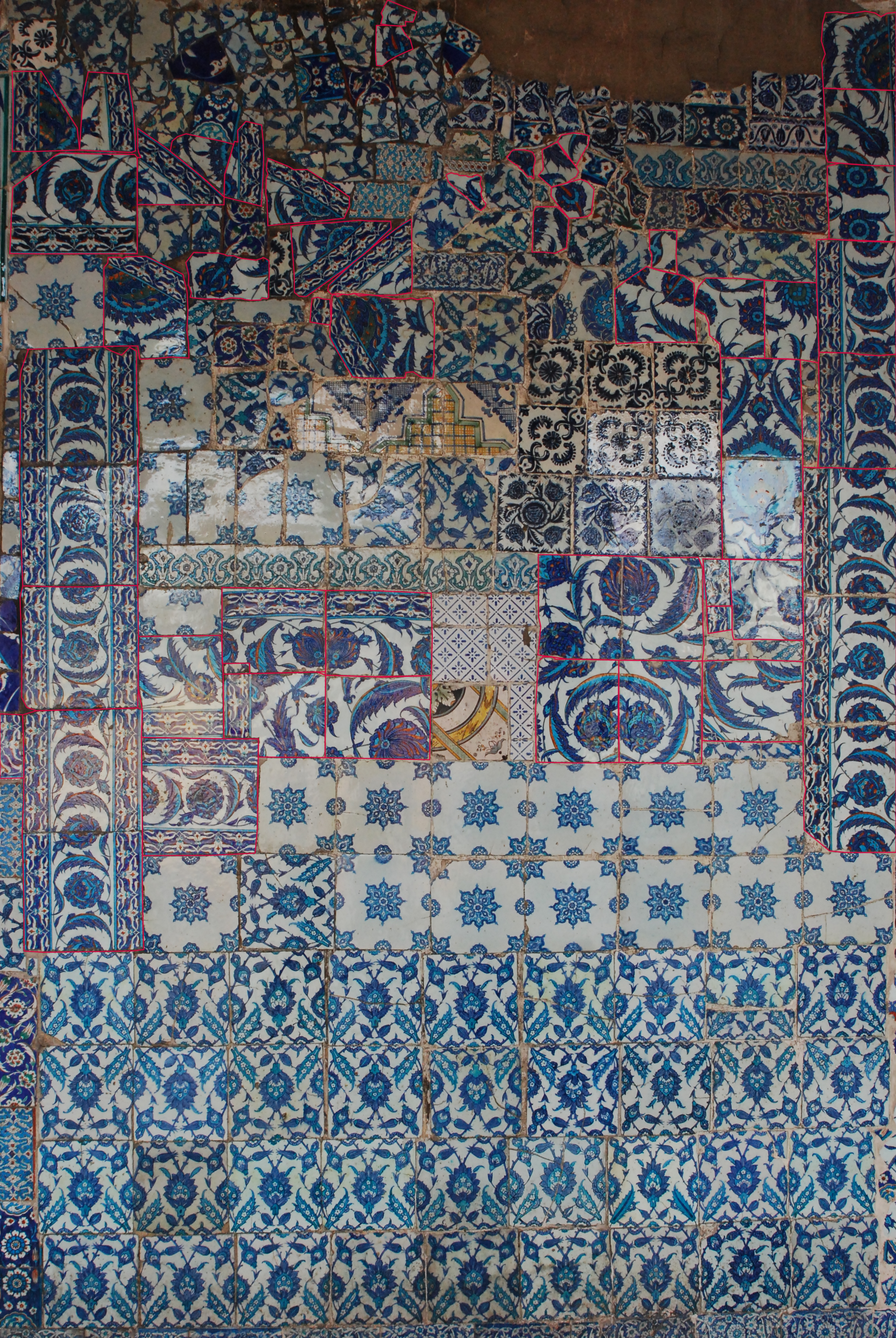
Reinserting the two tiles from Chicago where they belong (third row from the top, second and third columns from the right), the resulting layout is as follows:
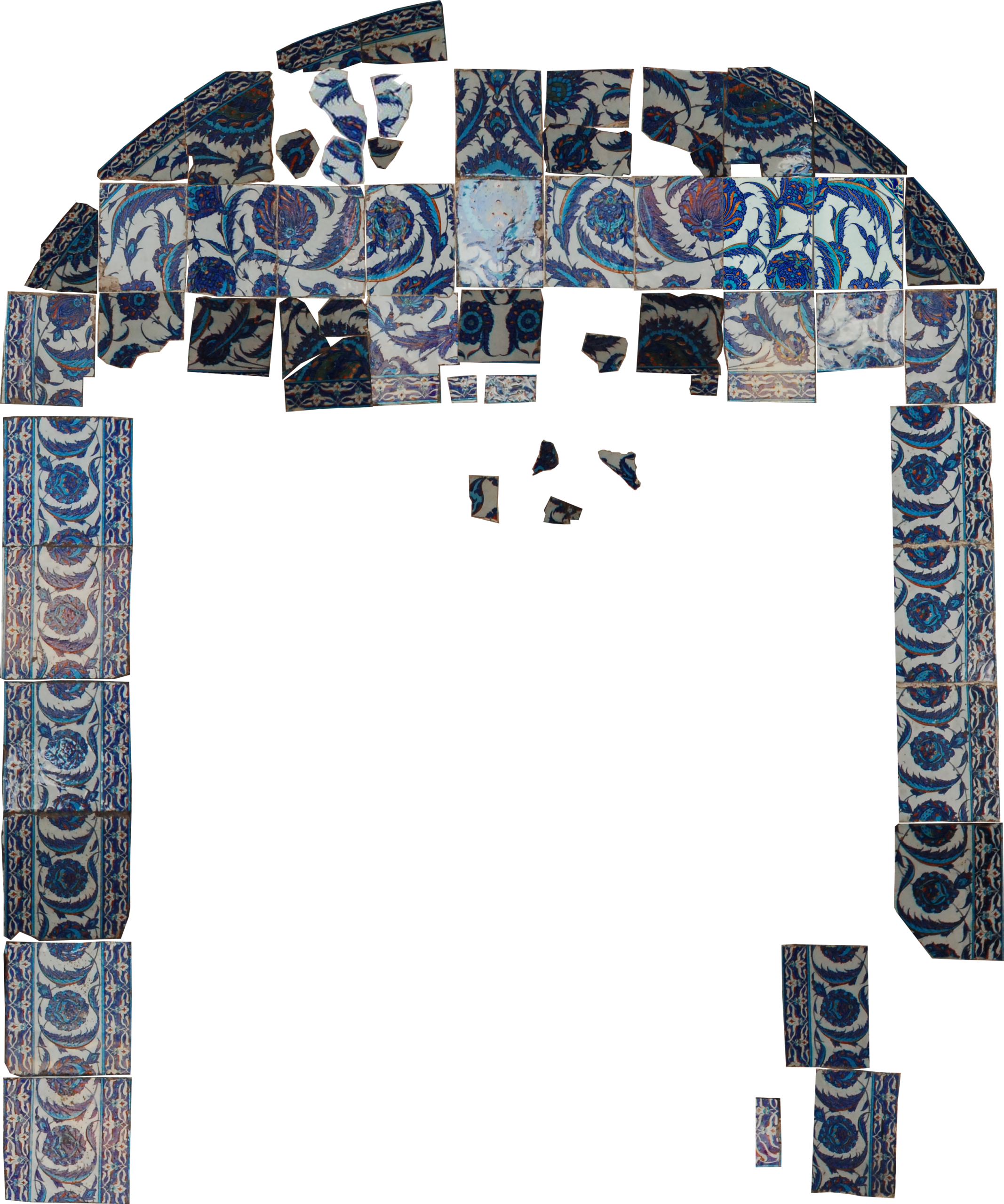
Finally, we can take advantage of the bilateral symmetry of the design to fill in almost all the remaining gaps, by mirroring whichever tiles survived (or look best) either on the left or the right:
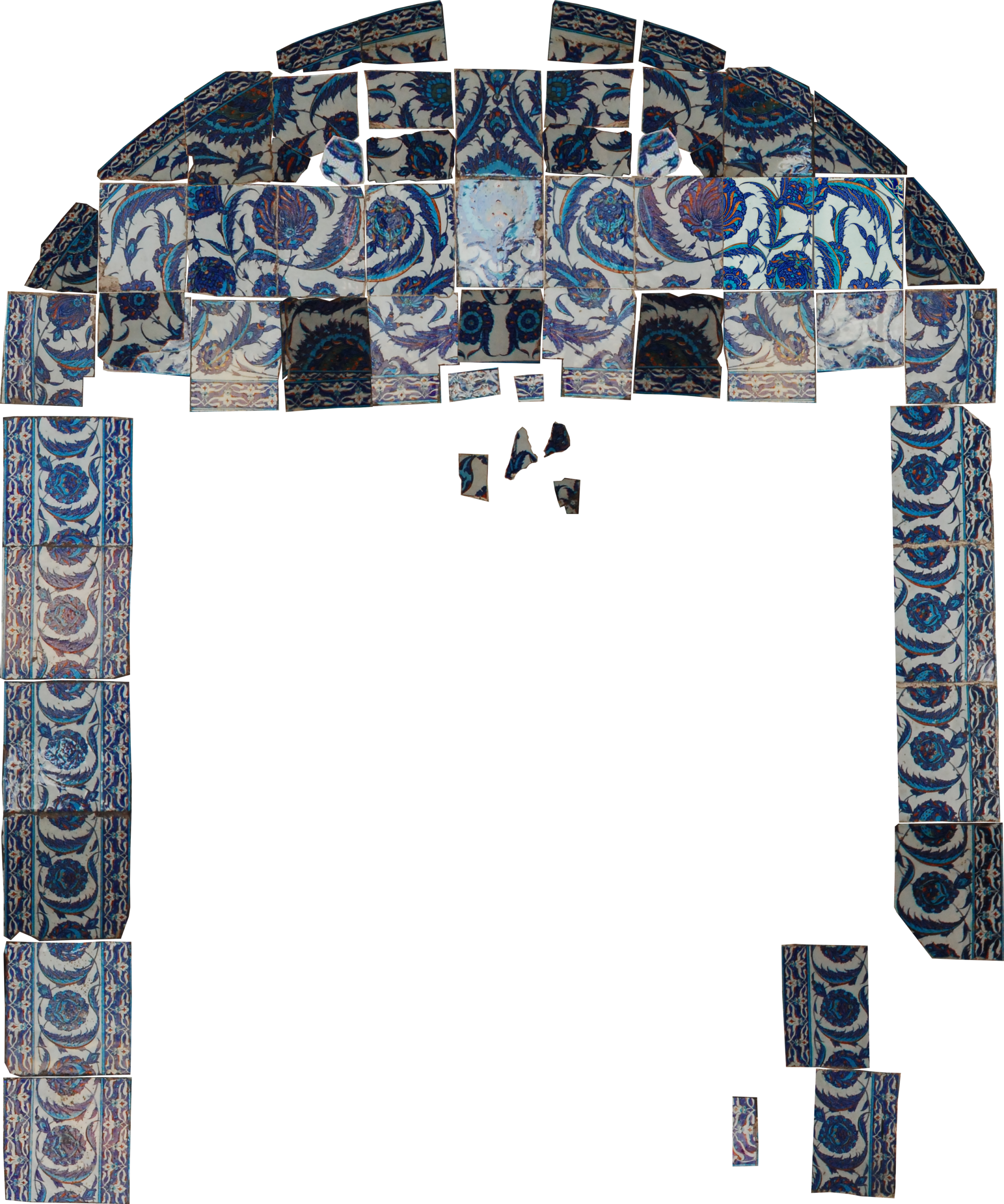
Only the very top tile seems to be missing, which is quite fortunate. I find it mildly surprising that whoever made this medley from the original tiles did not try harder to reconstruct the original layout, given so many pieces had been preserved. I am even more surprised that I could not find a modern reconstruction online, as it wasn't a difficult puzzle. If you know of one, please contact me on Instagram, so I can give it proper credit.
Looking closely, we see that the two bottom right tiles (shown here disconnected from the design) don't quite fit, as their pattern is the mirror image of what it should be. Instead they are identical with their counterpart tiles on the left. I assume this was an error, if not in what was ordered by Sinan's team, at least in what was delivered by the Iznik workshop, as the two mirror images can easily be confused if not looking carefully at how the two types of flower in them face relative to the saz leaves.
Similar Ottoman lunettes are on display at the MFA in Boston (a better photo of it is available on Wiki Commons) and at the Archaeology Museum in Istanbul.
The border around the lunette is a relatively common pattern, a near-identical border can be found in a contemporary panel from the Al-Adiliyya mosque in Aleppo (1557). It also appears on Damascus tiles, such as Figure 6.102 page 287 of Arthur Millner's book, where it can be seen more clearly that this border motif is a series of "squeezed" palmette motifs facing in alternate directions. That motif is sometimes known as the "Dome of the Rock motif", as a large number of Ottoman tiles with that motif appear on the outside of that building in Jerusalem. That motif in fact appears in the exterior tiles of the Rüstem Pasha mosque, and is shown at perhaps its most refined in the circumcision room of Topkapı Palace in Istanbul. The palmette motif itself has deep historical roots going to ancient Egypt through antiquity, as first (and rather loosely) discussed in Alois Riegl's Problems of Style.
I wish I had the skills and time to recreate this beautiful panel. More realistically, I have started on a watercolour painting of the two tiles from the Art Institute of Chicago, and will share the results hopefully in the near future.
I also look forward to seeing those tiles in the flesh (or more accurately, frit) during the September 2026 trip to Istanbul organised by Art of Islamic Pattern. There are spots remaining if you'd like to join. I went with them last year to Morocco and the trip was fantastic.
One
24 December 2025
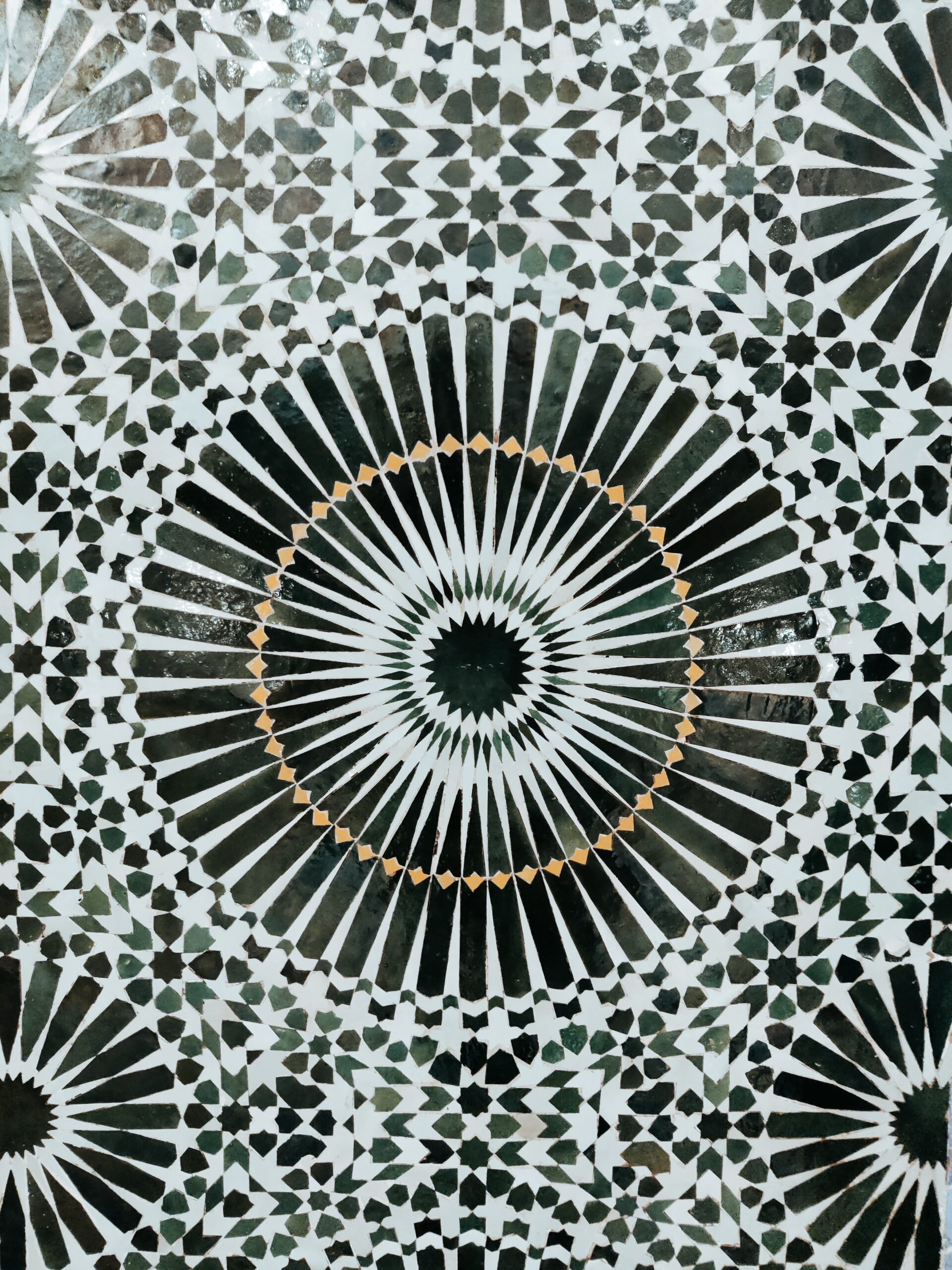
Zellij, Dar el Bacha Palace, Marrakesh (ca. 1910)
There is no god but God. First Shahada
I would like to start this blog with a bit of reflection on Islamic art, specifically on the concept of Unity (al-tawhid).
Unity is a universal idea running through several religions and philosophies, but it is essential in Islam, so much that it constitutes the first part of the profession of faith above. This is a rich and controversial topic -- central to the thought of Ibn Arabi, for instance -- and I am not remotely qualified to discuss it in depth, but it has important implications for Islamic art. Disclaimer: the following is just a series of reflections based on my readings, and intended as food for thought, not academic research.
---
In a religious sense, unity is closely connected to the idea of divine immanence, which features in a wide variety of traditions, from the Hindu to the Greek and Christian:
You are woman. You are man.
You are the youth and the maiden too.
You are the old man hobbling along with a staff.
Once born, you are the face turned in every direction.
You are the dark blue butterfly.
You are the green parrot with red eyes.
You are the thundercloud, pregnant with lightning.
You are the seasons, you are the seas.
You are without beginning, present everywhere.
You, from whom all worlds are born.
Shvetashvatara, Fourth Adhyaya, Upanishads 3-4
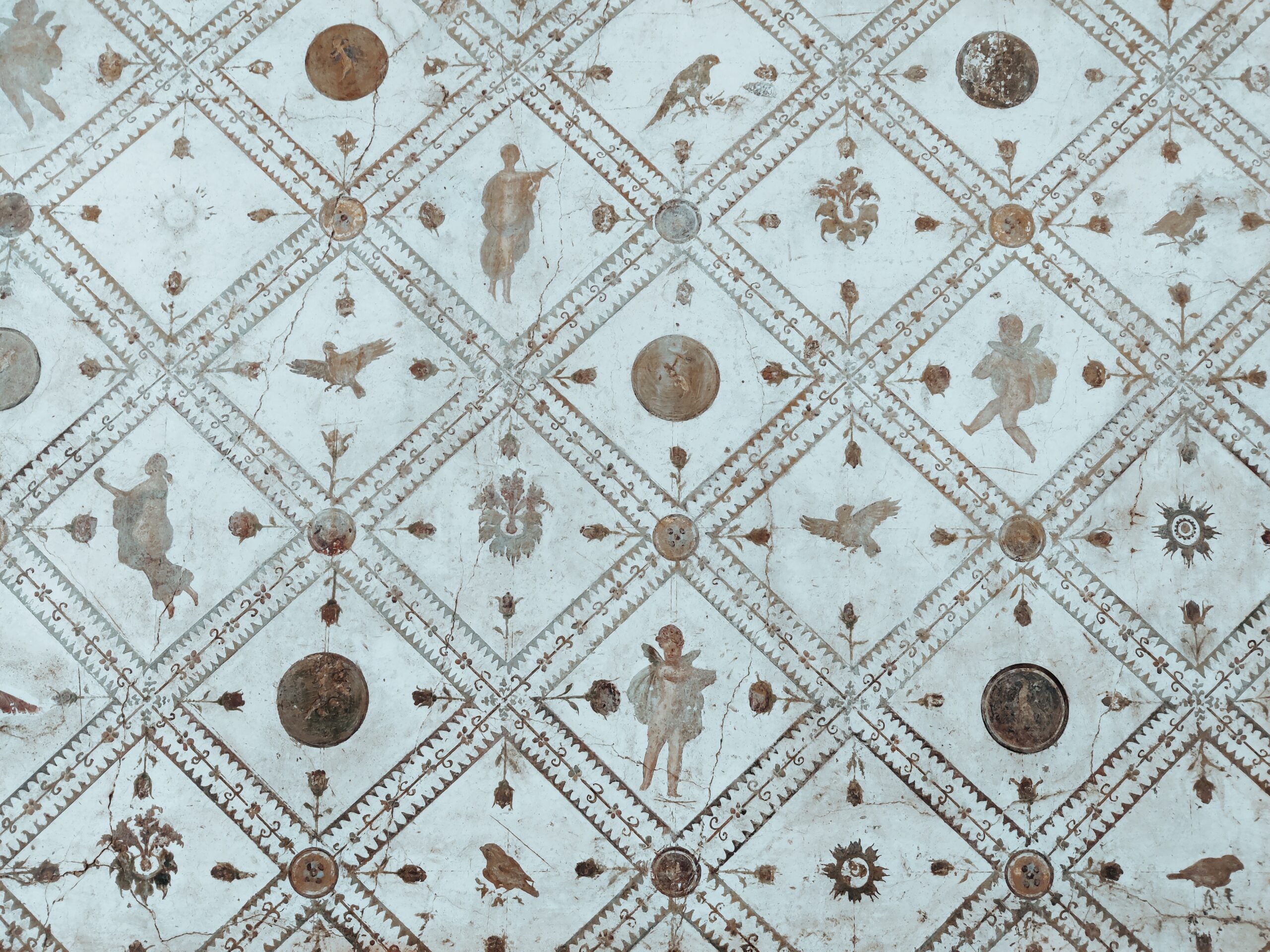
Wall painting, room 9, Ariadne's Villa, Stabiae (AD 54-69). Museo Archeologico Nazionale di Napoli
For there is in all natural beings something wonderful, and as Heraclitus reportedly told strangers who wanted to meet him but had stopped by the entrance after seeing him warming himself by his oven (indeed he invited them to boldly come forward into the kitchen, as "Gods are there too"), in the same way one should approach the study of all animals without disgust, because in absolutely all of them there is something natural, that is to say, beautiful.
Aristotle, The Parts of Animals, I.5
No doubt they do not know that you are here, everywhere,
That no place confines you, that only you is present,
Even for those moving away from you
Augustine, The Confessions, V.II.2
The immanence of God is repeatedly expressed in the Quran: We are closer to him than his jugular-vein (50:16); He is with you wherever you are (57:4); Indeed, Allah's help is (always) near (2:214); I am truly near. I respond to one's prayer when they call upon Me (2:186). It is also reflected in the rite of prayer, in that prayer can be performed anywhere. In the words of Bruckhardt:
[...] in fact, there is no profane art in the framework of Islamic civilisation, which admits of no scission between the domains of the “sacred” and the “profane”; there exists, at most, a difference of degrees between an art directly attached to religion, such as the architecture of mosques, for example, and an art of relatively worldly use, such as the architecture of palaces. Let us recall that every Muslim home is in principle a mosque, a masjid, that is to say a place where one can accomplish communal rites, a possibility never belied by the traditional house’s architectural forms or decoration.
Indeed God permeates space, time, and even the soundscape of the Islamic city:
The rhythm of urban life being determined by the times of prayer, the mosques with their minarets are located in such a way that the voice of the muezzin reaches every dwelling; hence the, so to say, acoustical layout of the town, one which is particularly evident in Fez.
Titus Bruckhardt, A Living Islamic City - Fez and Its Preservation
---
Unity also features prominently in modern science. Immanence could be expressed in mathematical terms as the density of a subset of a topological space. For instance, the rational numbers are a dense subset of the real numbers, as every real number either is a rational number or has a rational number arbitrarily close to it.
In classical physics, an example of unity is the principle of general relativity. One possible expression of it is that the equations describing the laws of physics have the same form in all frames of reference. This expression of unity results in an elegant, purely geometric description of gravity through Einstein's equations, by which space and time, already bound together by special relativity, are furthermore curved together by mass.
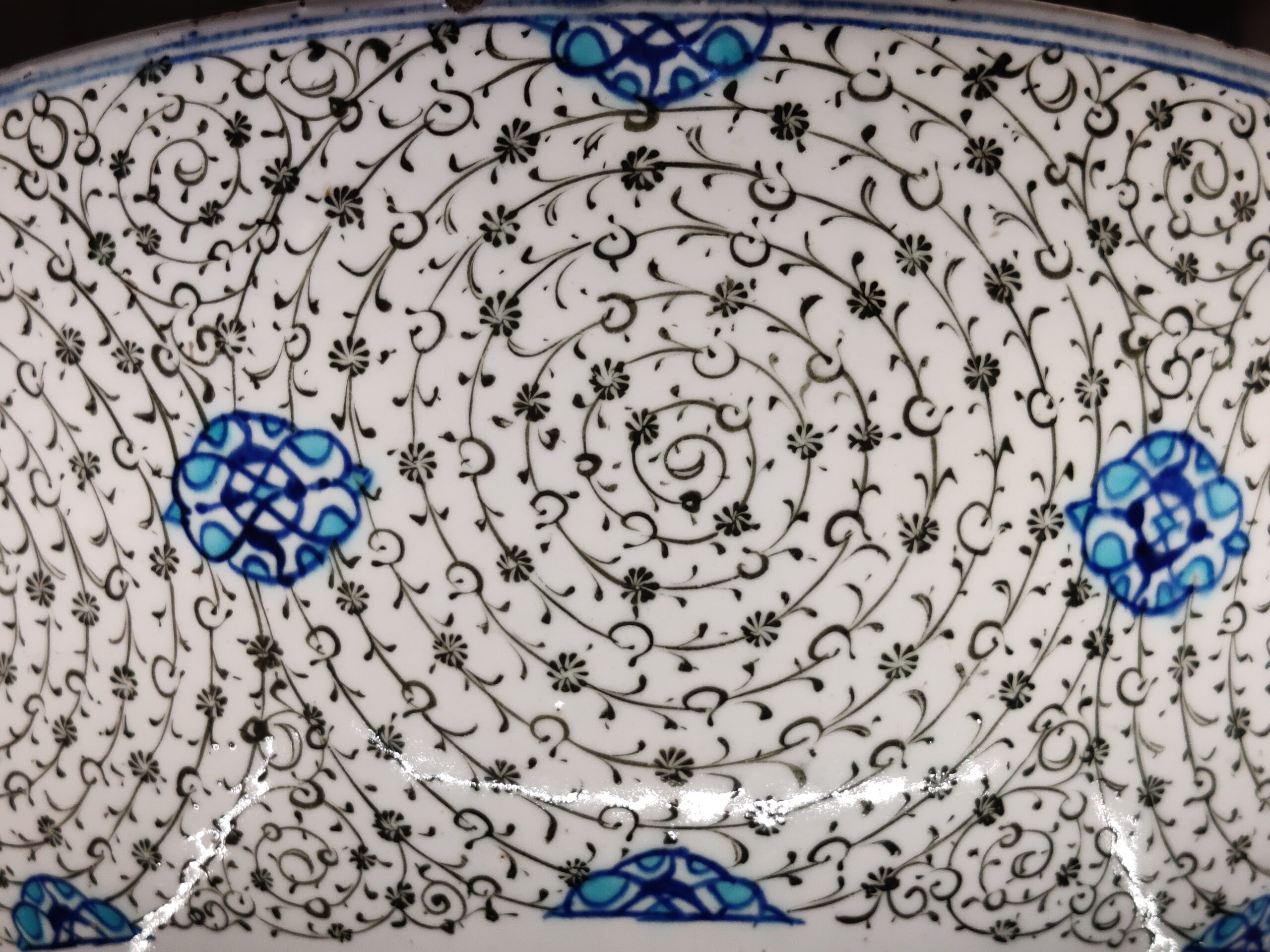
Basin with so-called 'Golden Horn' design, Turkey (probably Iznik) (ca. 1545). Fritware, underglaze painted in blue, turquoise and black. Victoria and Albert Museum, London
Molecular biology has revealed the unity of life on Earth, whose apparent diversity is merely the product of evolution. Just as importantly, there is unity in the evolutionary processes themselves - the same selective forces that operated in the past continue to operate in the present.
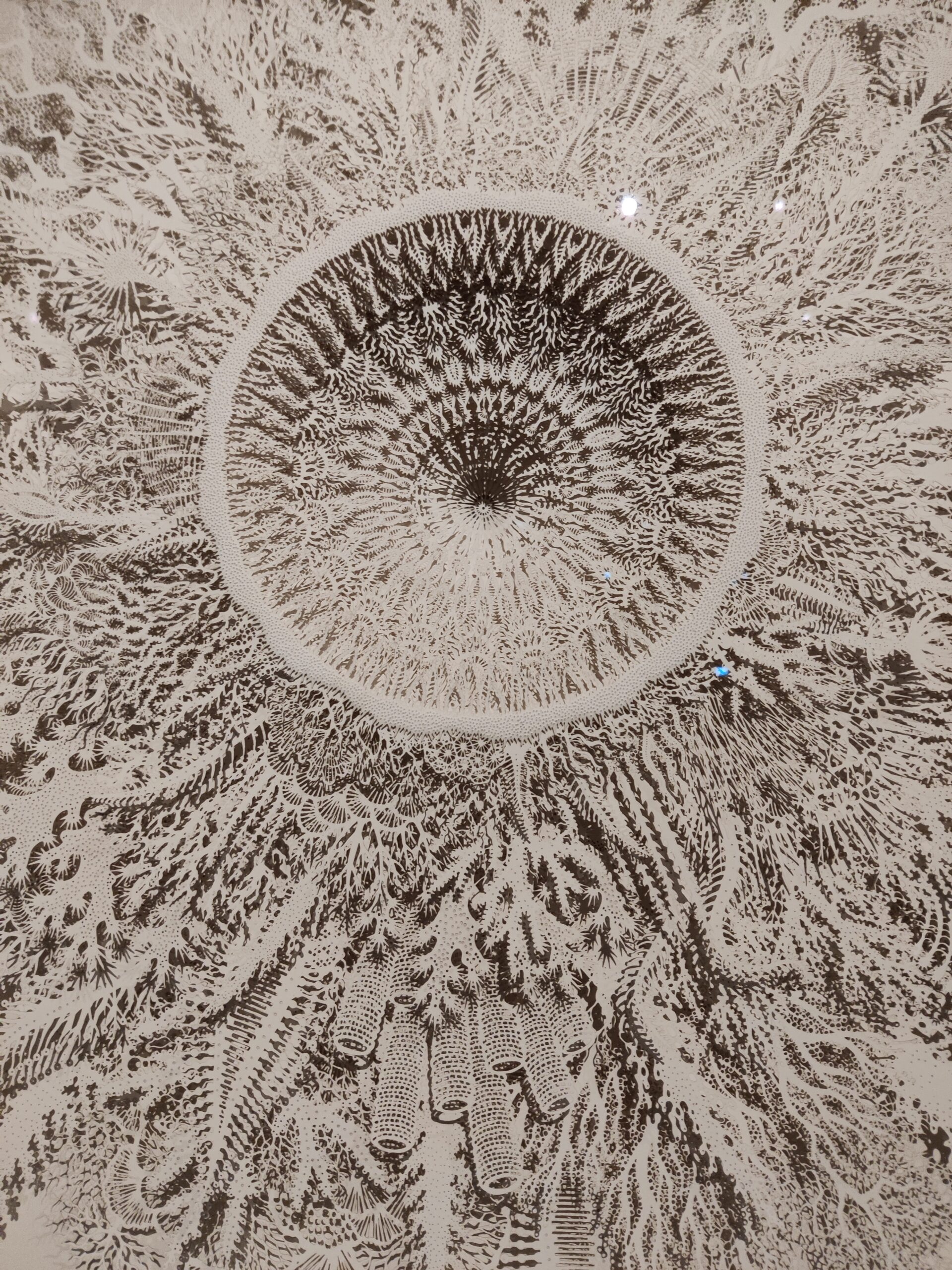
Ghost Coral Variation, Rogan Brown (UK, b. 1966) (2023). Laser- and hand-cut paper. Artist's collection, displayed at the 2023 Iris Van Herpen retrospective, Musée des Arts Décoratifs, Paris
That idea has close parallels in geology as uniformitarianism, as developed by Hutton and Lyell - that the processes that shaped the earth in the past are the same as today’s - and in comparative linguistics, where sound change plays the role of tectonics and erosion, and mapping its course over time reveals the unity underlying a language family:
The Sanscrit language, whatever be its antiquity, is of a wonderful structure; more perfect than the Greek, more copious than the Latin, and more exquisitely refined than either, yet bearing to both of them a stronger affinity, both in the roots of verbs and the forms of grammar, than could possibly have been produced by accident; so strong indeed, that no philologer could examine them all three, without believing them to have sprung from some common source, which, perhaps, no longer exists [...]
William Jones, third annual discourse before the Asiatic Society on the history and culture of the Hindus.
In physics, it seems to me that unity runs even deeper, in the empirical fact that the universe is intelligible. That is, the abstract mathematical objects of the mind, which might appear at first quite disconnected from our immediate experience, can be used to describe reality to a close approximation at a very fine scale. For example, the so-called imaginary numbers originated as a fudge to solve polynomial equations, and Descartes, who did not invent them but coined the term, stressed that they did not correspond to any quantity in the real world. But complex numbers - which have both real and imaginary parts - turned out to be essential to the quantum description of reality, for instance complex Hilbert spaces. In a similar vein, another by-product of efforts to solve polynomial equations was Galois' group theory. A century later, as an attempt to solve partial differential equations, Lie extended that theory from Galois' discrete groups to the continuous groups that now bear Lie's name. Those groups turned out to play an essential role in quantum field theory (I heartily recommend Klauber's Student-Friendly QFT to learn about this fascinating but tricky foundational theory of physics). As a final example, Emmy Noether showed that symmetry, though arguably more clearly connected to our immediate experience, plays an unexpectedly deep role in physics (see Schwichtenberg's Physics from Symmetry for an interesting discussion of it).
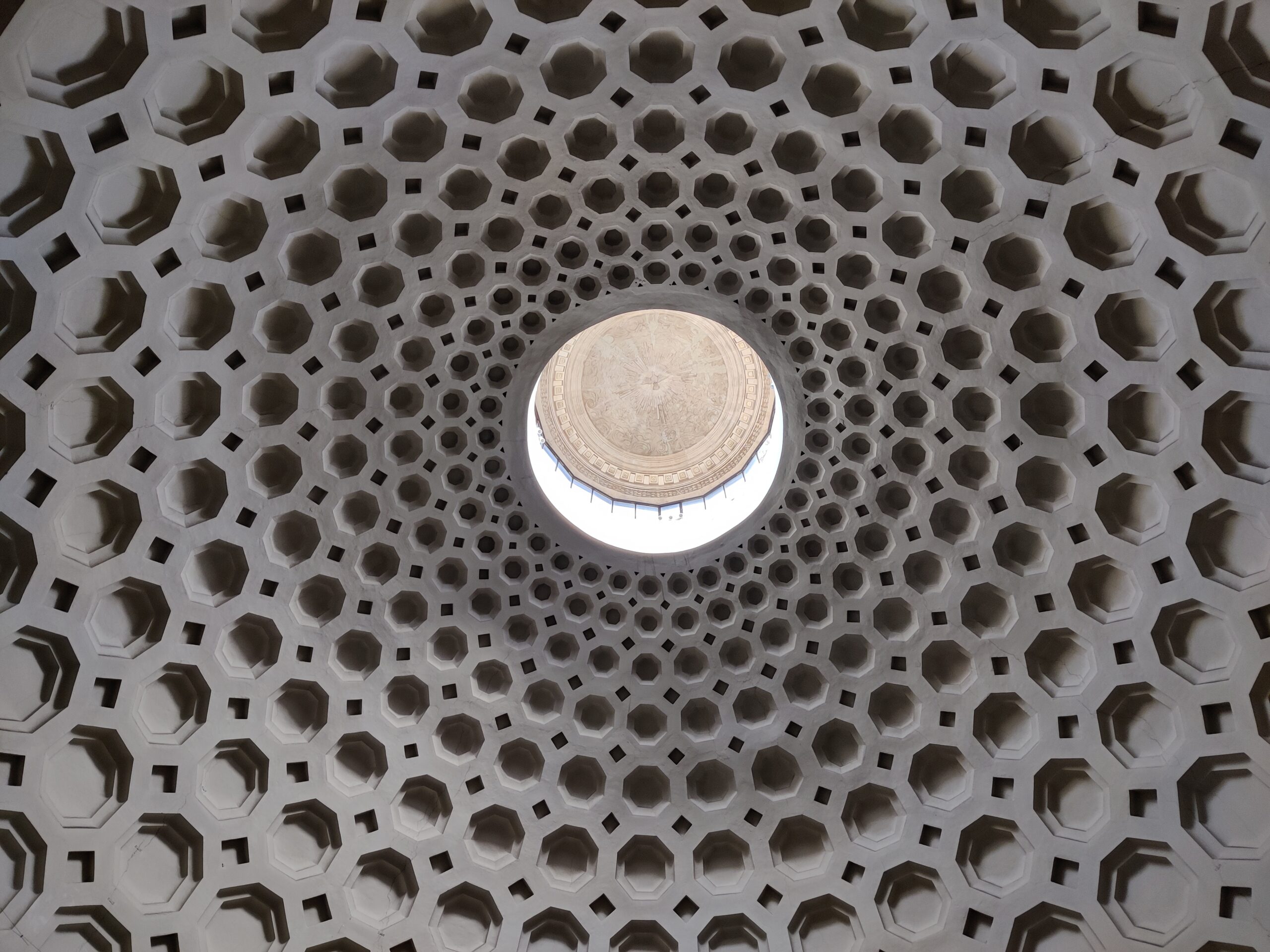
Interior of the dome of the Chiesa di San Bernardo alle Terme, formerly a pavilion of the Baths of Diocletian (AD 298-306), Rome
Going back to our main topic, that connection between mind and physical reality is very much alive in Islamic art:
Islam’s concentration on geometric patterns draws attention away from the representational world to one of pure form, poised tensions and dynamic equilibrium, giving structural insight into the workings of the inner self and their reflection in the universe.
Keith Crichtlow, Islamic Patterns: An Analytical and Cosmological Approach.
One can rightly say that, on the whole, the craftsman or the artist never took care to perfect his tools, nor to choose the most durable of materials, at the same time as he applied himself with much zeal and great skill to the perfection of his work. This attitude is explained at least in part by the Muslim’s very keen awareness that all things are ephemeral; art always remains something provisional – “all that is here-below will perish”, says the Koran (55:26) – and its best fruit is the mastery that the craftsman gains over himself. Here we touch upon the point where art converges – or can converge – with a spiritual discipline, something which explains the affinity that exists between the craft guilds and the brotherhoods issuing from tasawwuf. In the same way that the craftsman transforms a more or less amorphic or raw material into a perfect and noble form, the contemplative or Sufi transforms his own soul.
Titus Bruckhardt, A Living Islamic City - Fez and Its Preservation
So we see that unity in Islam is reflected in the unifying character of Islamic art in both aims and practice. For example, Sinan's development as an architect was primarily driven by his aim to unify a mosque's architectural space - reflecting that a mosque has a direction (towards Mecca) but is fundamentally a single shared space for prayer, as Islam does not have equivalents to the liturgical material requirements (such as altars or processions) which structure the space of a Christian church.
According to Burckhardt, unity in Islam is reflected in the unity of fine art and decorative art, of art and craft, and the continuity of the creative act in religious and artistic senses:
What our ancestors put into the forms of their environment, this acts anew upon us, their heirs; there is nothing that exercises a greater influence on a man’s soul than the environment which surrounds him. Or rather yes, there is something that comes before, and that is dress, for nothing influences our attitude as much as dress. Architecture comes next: firstly, the architecture of interiors, then architecture in general, and finally, the architecture or a city, town-planning. As a result of this, the need for art is not a purely aesthetic question; art is a vital reality which man could never do without.
[…]
Let us also recall in this context that the Arabic language (sani) makes no distinction between art and craftsmanship, and for good reason, since this distinction is only due to the very particular development of European art since the Renaissance. In all traditional civilisations, art is never dissociated from its practical goal, and craftsmanship is never limited to a production deprived of beauty. To reach this debased state industry was required, and with it the machine. Before that era, the most modest trade had its ideal of perfection, a perfection that necessarily implied beauty, in the sense of the Arabic word ihsan, which has precisely the two meanings (“God has prescribed excellence (=beauty) for all things” (Hadith)). A perfection that excludes beauty is not in conformity with the integral nature of man.
The close link between art and craftsmanship fills the Islamic world with beauty. The art of Islam, moreover, is essentially an art of environment: architecture, woodworking, metalworking, ornamentation, and even calligraphy all serve to fashion man’s living environment, figurative art being the exception. “God has created you and what you make”, says the Koran (37:96), thereby indicating two phases of Divine creation: a direct creation whose object is man’s nature in its totality, and an indirect creation through man, whose object is the latter’s environment. In order for man’s creative act to be a conscious prolongation of the divine Act, he must confer upon the things he fashions their state of natural perfection. Now, it is precisely this which Islamic art seeks: it confers upon raw material a state of crystalline perfection by using the most simple and direct means, such as the geometrical arrangement of forms and the cladding of surfaces by colored panels or sculptured ornaments which lend to them a luminous vibration. The Muslim artist works like an alchemist who makes gold from base lead.
[…]
Sacred calligraphy, which attained an unprecedented perfection in the world of Islam, is as regards the Koran and its text, analogous in the visual order to psalmody of the Koran in the auditory order. This psalmody was encouraged by the Prophet himself and creates a kind of link between the revealed Word and music, just as calligraphy creates a link with the Word of the Koran and visual art.
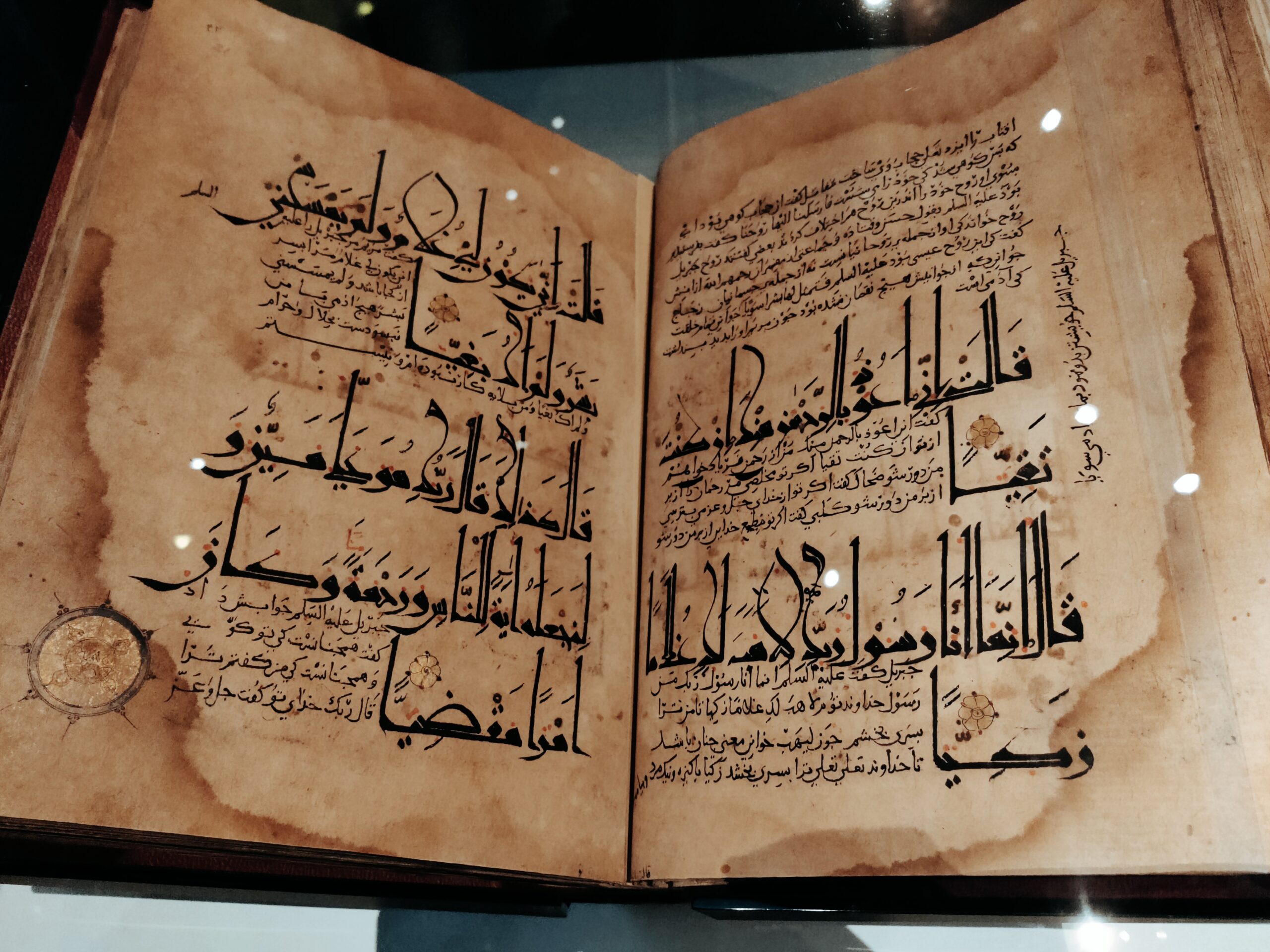
Koran written in cursive and broken cursive (aka Eastern kufic) scripts, 2024-25 Silk Roads Exhibition, British Museum, London
[…]
The most obvious artistic symbolism of tawhid is undoubtedly that of light, a symbolism which moreover has its basis in the Koran: “God is the Light of the heavens and the earth” (24:35). Be it modified, coloured, or attenuated by shadows, light always remains unique and essential light. Its nature does not change, but permits of an infinite number of gradations between brightness and darkness, and between the different colours. The true substance of Maghribi art is light: the mosaic of enameled tiles reflects and refracts it into colours, and the ornaments of sculptured stucco capture and distil it, the walls in both cases seeming to become translucent. As for the darker wooden panels, which constitute the special charm of Moroccan architecture, they enhance by way of contrast the luminous character of the other elements.
[…]
“Verily, God is beautiful and He loves beauty” (Hadith).
[…]
We said that the hands of the craftsman confer upon each of his works something unique. However, one must not believe that the craftsman or artist – he is both at the same time – proceeds by an arbitrary or individualistic choice of forms. The formal language of art is faithful to the spirit of Islam, which excludes subjectivism and promethean fantasies. For the artist, it is a question not of feeling, but of method: tradition has put at his disposal an ensemble of formal elements which constitute a language and which must be used according to the laws inherent to this language, such that one could speak of a grammar or syntax of forms which one can master but not violate. The forms themselves, however, can and should be developed according to circumstances, in a manner analogous to the development of a “mode” in traditional music, where there is a certain sonorous scale, then modes, and finally melodic schemes which can be developed on the outline of a given mode. This law, though strict, guarantees at the same time a certain creative liberty, for, thanks to it, traditional musicians can improvise on the impulse of the moment without ever being in dissonance with their orchestra companions.
[…]
“When a piece of European music begins,” a master musician of the Punjab once told us, “we never know where it will end, whereas we already know that we will return to the centre from which we left.” This is equally true for our mosaicist: after assembling the small ceramic pieces and setting them with a layer of mortar, and after delicately detaching this mosaic sheet from the floor and applying it to the wall, we will see that the least element of his “spider web” is integrated into a harmonious ensemble, where everything radiates from a centre and returns to it, in accordance with the Koranic assertion that “unto God all things are returned” (3:109).
That musical metaphor reminds me of a passage by Zhuangzhi:
Sir Shoestrap of Southwall replied, “When the Great Clump belches forth its vital breath, we call it the wind. As soon as it begins, raging cries emerge from all the ten thousand hollows, and surely you cannot have missed the rustle and bustle that then goes on. The bulges and drops of the mountain forest, the indentations and holes riddling its massive towering trees, are like noses, months, ears; like sockets, enclosures, mortars; like ponds, like puddles! Roarers and whizzers, scolders and sighers, shouters, wailers, boomers, growlers! One leads with a “yeee!,” another answers with a “yuuu!” A light breeze brings a small harmony, while a powerful gale makes for a harmony vast and grand. And once the sharp wind has passed, all these holes return to their silent vacuity. Have you ever seen all their tempered attunements, all their cunning contentions?”
Sir Swinny Faceformed said, “So the piping of the earth means just the sounds of these hollows. And the piping of man would be the sound of bamboo pipes. What then is the piping of Heaven?”
Sir Shoestrap said, “It is the gusting through all the ten thousand differences that yet causes all of them to come only from themselves. For since every last identity is only what some one of them picks out from it, what identity can there be for their rouser?
“A large consciousness is idle and spacey; a small consciousness is cramped and circumspect. Big talk is bland and flavourless; petty talk is detailed and fragmented. We sleep and our spirits converge, we awake and our bodies open outward. We give, we receive, we act, we construct, trying to make something of whatever we encounter: all day long we apply our minds to our struggles–some straightforward, some deeply buried away, some dogging us closely. The small fears leave us nervous and depleted, the large fears leave us stunned and blank. Shooting forth like an arrow from a bowstring: thus is our presumption as we arbitrate right and wrong. Holding fast as if to sworn oaths: thus is our defense of our victories. Worn away as if by autumn and winter: such is our daily dwindle, the flailings of a drowning man unable to get him any closer to the shore. Pressed on all sides as if sealed in: such is the old drainage ditch, the rut in which we’re stuck, the mind left on the verge of death with no way back to the bygone vitality.
“Joy and anger, sorrow and happiness, plans and regrets, transformations and stagnations, unguarded abandonment and deliberate posturing–music flowing out of hollows, mushrooms of billowing steam! Day and night they alternate before our eyes, yet no one knows whence they sprout. Let us stop right there, no need to go further! Already it is constantly coming to us day and night, this from which they are all born! Without that there is no me, and yet without me there is nothing picked out from it. It is something that is always very close to me indeed, and yet still I can never know what is doing the causing here. If there is in fact something in control of causing all this to happen, it is peculiarly devoid of any sign that could identify what it is. Even when its ability to act has been so reliable, it shows no definite form. It would have to be some kind of reality that lacks any definite form, a reality without any single identity.
Zhuangzhi, Inner Chapters 2. Equalizing Assessment of Things
The Upanishads also express unity through musical repetition:
This earth is (like) honey to all beings, and all beings are (like) honey to this earth.
This water is like honey to all beings, and all beings are like honey to this water.
This fire is like honey to all beings, and all beings are like honey to this fire.
This air is like honey to all beings, and all beings are like honey to this air.
This sun is like honey to all beings, and all beings are like honey to this sun.
Upanishads, Brihadaranyaka, Second Chapter, Fifth Brahmana (Madhu-Brahmana)
To end with a final -- and motivational -- digression, the idea of a continuity between God's creation and man's (artistic) creation in Islamic art is also evoked by Rilke from a Christian/pantheistic perspective:
"The thought of being a creator, of engendering, of shaping" is nothing without its continuous great confirmation and embodiment in the world, nothing without the thousand-fold assent from Things and animals - and our enjoyment of it is so indescribably beautiful and rich only because it is full of inherited memories of the engendering and birthing of millions. In one creative thought a thousand forgotten nights of love come to life again and fill it with majesty and exaltation.
[...]
Why don't you think of him as the one who is coming, who has been approaching from all eternity, the one who will someday arrive, the ultimate fruit of a tree whose leaves we are? What keeps you from projecting his birth into the ages that are coming into existence, and living your life as a painful and lovely day in the history of a great pregnancy? Don't you see how everything that happens is again and again a beginning, and couldn't it be His beginning, since, in itself, starting is always so beautiful? If he is the most perfect one, must not what is less perfect precede him, so that he can choose himself out of fullness and superabundance? Must he not be the last one, so that he can include everything in himself, and what meaning would we have if he whom we are longing for has already existed?
As bees gather honey, so we collect what is sweetest out of all things and build Him. Even with the trivial, with the insignificant (as long as it is done out of love) we begin, with work and with the repose that comes afterward, with a silence or with a small solitary joy, with everything that we do alone, without anyone to join or help us, we start Him whom we will not live to see, just as our ancestors could not live to see us. And yet they, who passed away long ago, still exist in us, as predisposition, as burden upon our fate, as murmuring blood, and as gesture that rises up from the depths of time.
Is there anything that can deprive you of the hope that in this way you will someday exist in Him, who is the farthest, the outermost limit?
Dear Mr. Kappus, celebrate Christmas in this devout feeling, that perhaps He needs this very anguish of yours in order to begin; these very days of your transition are perhaps the time when everything in you is working at Him, as you once worked at Him in your childhood, breathlessly. Be patient and without bitterness, and realize that the least we can do is to make coming into existence no more difficult for Him than the earth does for spring when it wants to come.
Rilke, Letters to a Young Poet, No 4, 6, 7, 8
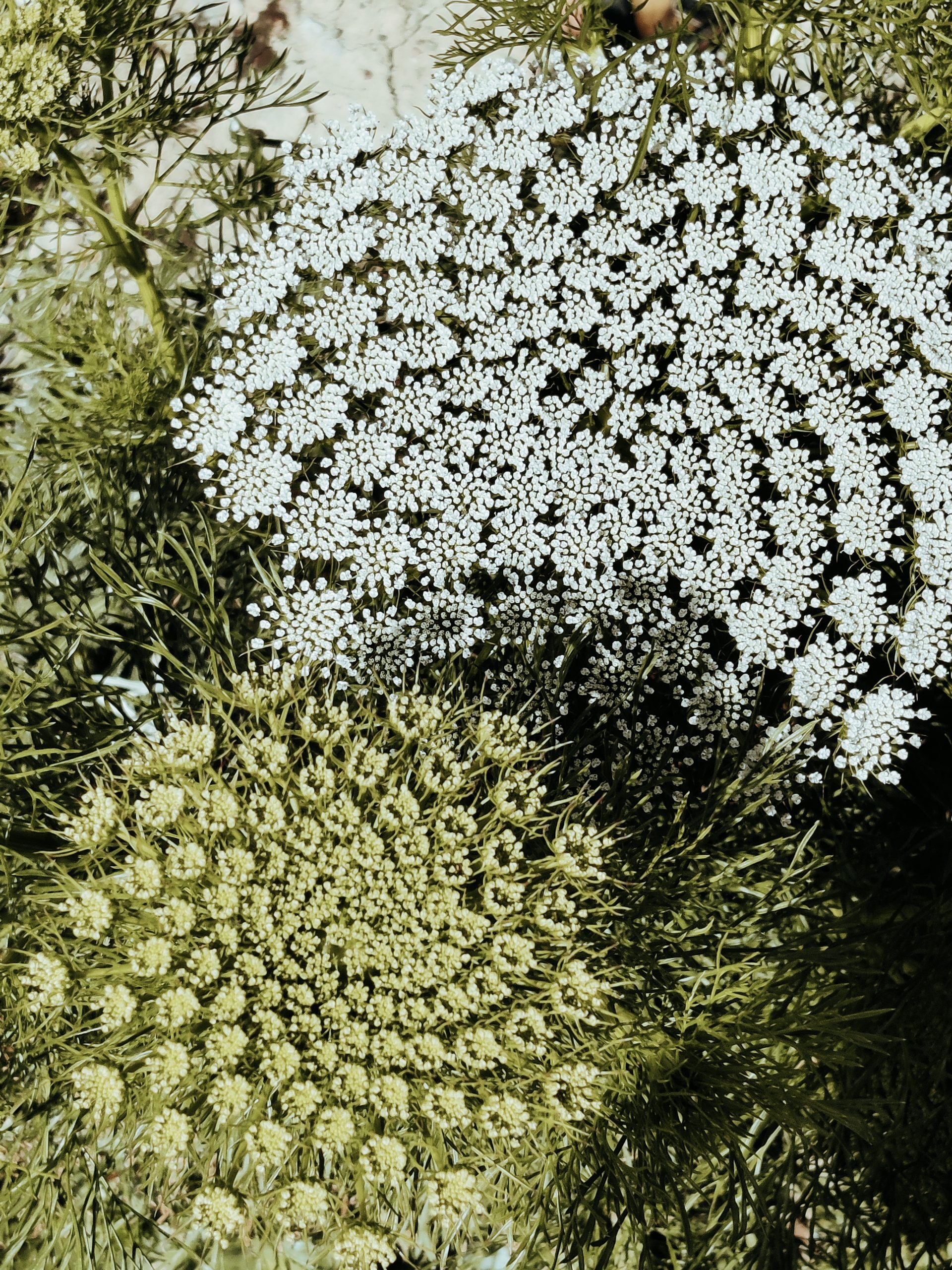
Wildflowers, Fes, Morocco
All photos (c) Jeremy Darot.